I hated dieting. That part, you probably know.
But why? It wasn't that I was unwilling to eat differently or even somewhat less. It was the labor diets required (and the attendant joylessness).
What's interesting about modern dieting (and the truth is, all diets are modern because the underlying cause is industrial food) is that the remedy is always complex. Logging, counting, imagining food as points, and watching the clock for when you can eat again are laborious.
But choosing food happens many times a day. If each instance is laborious, you may rely on pre-made, highly processed foods or quit the diet early. Most January diets are abandoned by February 14th.
Since eating isn't something we can get around, two things must happen.
- You need an easy way to choose foods that protect your healthy weight.
- You need to be able to quickly make them into meals with a minimum of friction (see COOK!) 🥑
My superpower is creating simple ways to navigate complexity. In this case, with food and health.
I help people connect health information (what they know) with how to live it (what they do) because the latter is the hard part. Look at all the creators eagerly dissecting the latest studies. There's lots of technical information and very little about how to make this real in your own life.
That's why overloading yourself with ever-increasing health information can lead to neuroticism or inaction. It's just too much.
What's happening is that your life has friction that needs to be addressed.
You can tackle the stickiest issues by making it easy to do the hard thing—in this case, consistent, healthy eating.
In the case of food selection, it's pretty well known at this point that most of what's at the grocery store isn't good for you. The friction is in the choosing (and making, which I address in COOK!) 🥬
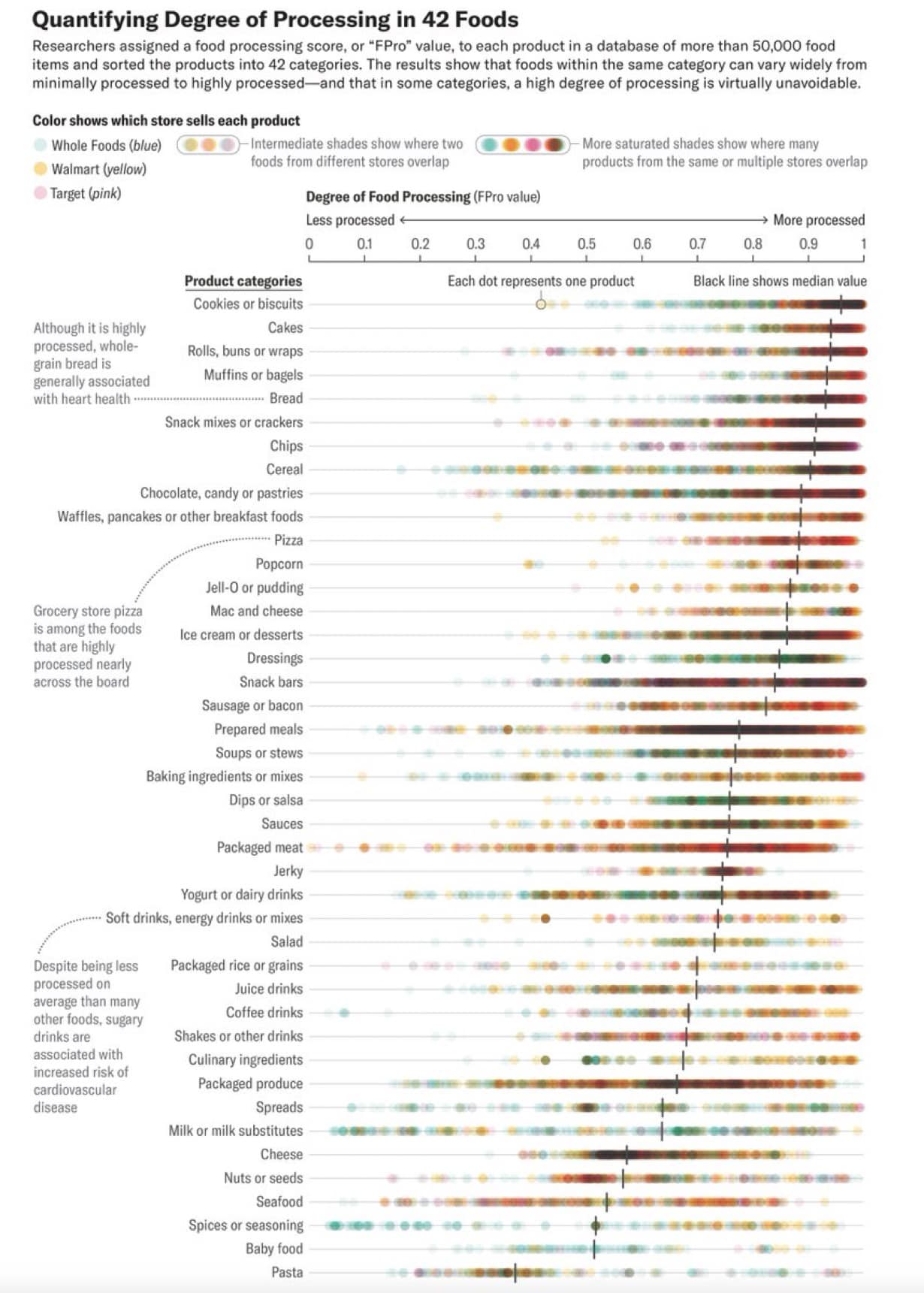
Most grocery stores seem to offer endless options in their aisles, which are full of cereals, pastas and baked goods available in hundreds of shapes and flavors. But a closer look at the ingredient lists of these foods shows that for some of them, there’s not much choice at all. A new study has found that most of the products on our grocery shelves have one thing in common: they’re highly processed.
The good news is that scientists created a database to rank commonly purchased foods by their processing.
The bad news is that it looks like this 😵💫
Here's my system. It allows you to categorize any food into five buckets and determine how much of your diet should include that type of processing. It's simple, repeatable, and smart.

I built this for you.
Many years ago, I realized that the only way out of this mess was to eat real food (the green and yellow on this chart), and everything else got severely limited.
That's what's allowed me to:
Eat when I was hungry, stop when I'd had enough, and have that produce a consistent healthy weight.
Now, going on 15 years ✌️
Curious about a food? Join the group and post a question.
How to work with me:
- Learn to make real food–without recipes, gadgets, or hours of prep.
- Take my sugar course 🍭
- Get the (updated) FREE food processing pdf
- Hit reply and ask me a question!
What I'm reading.
I love it when one question clarifies your situation. This is one.
Scientific American has loads of great articles about the effects of ultra-processed foods. This one is about their addictive nature, and this is the one about the ranking system discussed above.
Help me thoughtfully build this community.
Send this email to a friend. They can sign up here ⤵️
 |
Yours in joyful eating and living,